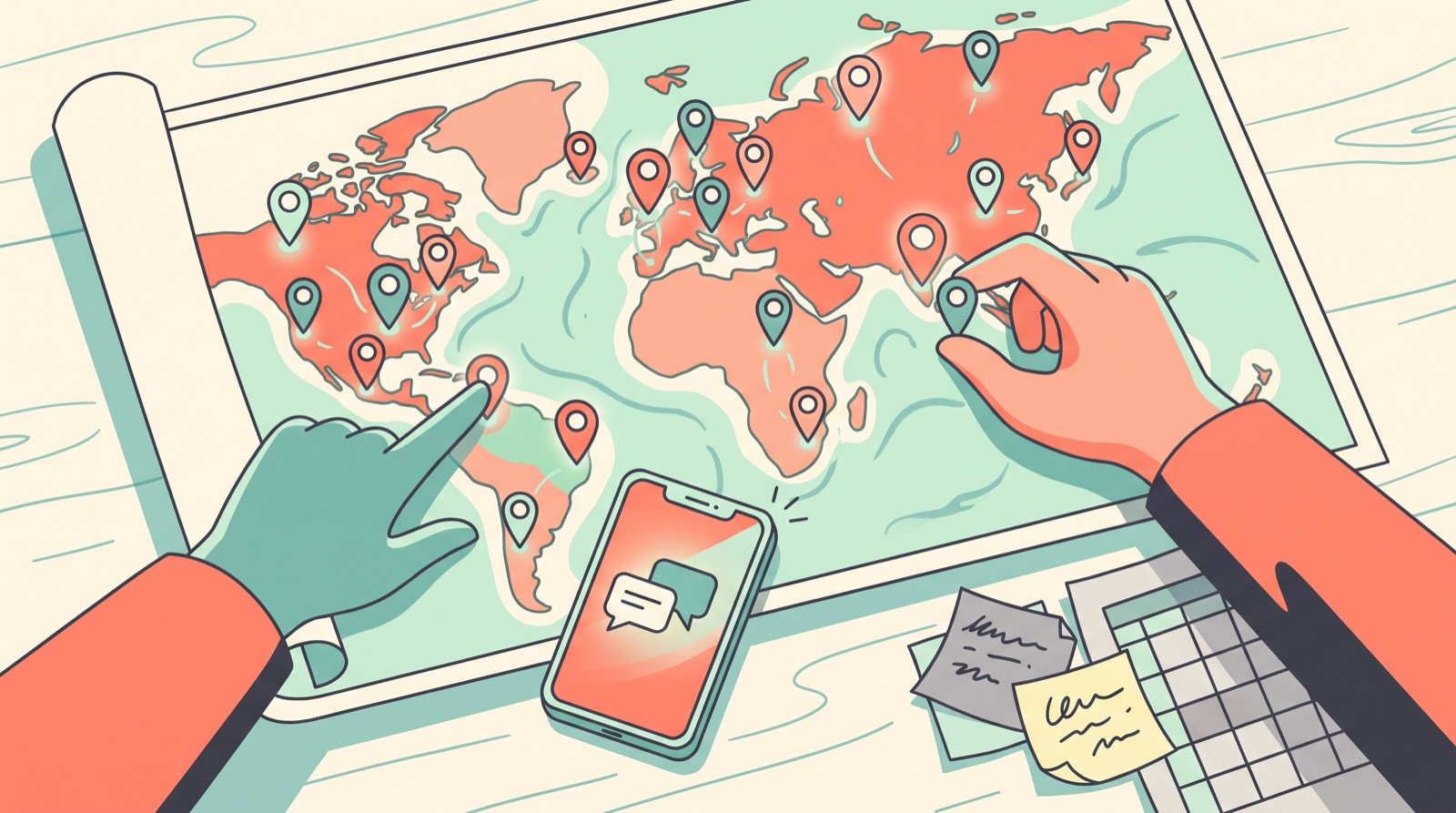
Everyone's planning process has the same failure mode eventually. A shared Google Doc that turns into a wall of unformatted links. A Notion template someone built with real enthusiasm in January that nobody's opened since. A group chat where "we should go to that place" refers to four different places depending on who you ask. The app doesn't matter until the moment it does, and by then you're usually two weeks from a flight, arguing about a spreadsheet.
So instead of ranking specific apps against each other, here's what's actually worth asking before you commit to one for your next trip.
Is it built for a group, or does it just allow one?
There's a real difference between an app that was designed for collaborative planning and an app that was designed for one person and later got a "share" button bolted on. The tell is what happens when more than one person tries to use it at the same time. Can everyone add spots independently? Can the group actually vote on what stays and what gets cut, or does one person have to manually reconcile five people's opinions into a final list? If the answer to "what happens when six people all open this at once" is "it gets messy," that's not a group planning tool, it's a personal list with a link you can send.
Does it meet you where you're already finding places?
Nobody starts trip research with a blank list anymore. It starts with a TikTok saved at 1am, an Instagram Reel a friend sent, a Google Maps pin from a "places to visit" list. The real question isn't whether an app lets you add places, it's whether it can take what you already saved and turn it into something usable, pulling the actual place out of a video link rather than making you retype the name from memory into a search bar. An app that assumes you're starting from zero is solving a problem you don't actually have.
Is the map load-bearing, or is it decoration?
A lot of trip planning tools have a map because trip planning tools are supposed to have a map, not because the map does anything. The real test: if you saved fifteen spots across a city, could you actually look at the map and understand the shape of your days, what's near what, what's a reasonable walk versus a cross-town trek? If the map is just a static image sitting above a list, it's not actually part of the planning, it's a screenshot with extra steps.
Does it survive contact with an actual group?
This is the one that breaks the most tools. It's easy to build something that works when one careful person is using it slowly. It's much harder to build something that holds up when six people are adding, editing, and voting on things simultaneously, from different time zones, over two weeks, without anyone's changes getting silently overwritten. If a tool has never been tested by an actual chaotic group trip, it will show you exactly where the cracks are, usually the week before you leave.
Where Routely actually fits into this
We built Routely around these exact questions, mostly because we got tired of the Google Doc and Notion template failure modes ourselves. Everyone in the group can add and vote on spots, saved TikToks and Instagram links resolve into real places on a shared map instead of a list of half-remembered names, and the map is genuinely part of how you plan, not a decoration at the top of the screen.
That doesn't mean it's the only answer. It means these are the actual questions worth asking, regardless of what you end up choosing.